
On July 14 2023, the day after I said goodbye to Ruby Vroom, I made myself a promise: I was going to take better care of my body. Focus all the love and attention I’d lavished on her, on me.
Not in a new-year-new-me, buy-the-leggings way. More like someone who had just been stripped down to the studs and needed to find out what was still standing.
When Ruby was diagnosed with terminal cancer, a part of me started dying too. That sounds dramatic, and it was. It was a physical, mental, and emotional breakdown of pretty much everything I understood myself to be. I wrote about what grief did to me a few months later, but I haven’t said much about the body part of it.
Because it wasn’t only Ruby. Her death was the thing that broke the dam, but there was a lot of water stacked up behind it. Perimenopause was doing its thing. I had been losing muscle without really noticing. I was deeply depressed. And I was only beginning to understand the conditions I grew up under, and how much they had shaped the adult I became. All of it at once left me feeling completely worn down by life.
But in my view I had one thing going for me: For a long time I was a yoga instructor. I know how to move a body. I couldn’t fix everything, but I had to put my attention somewhere, and so I put it there. Three years later, I’m still there.
Where I Started
I started small. HIIT workouts, essentially just bodyweight exercises, whatever I could do in my living room without thinking too hard about it. I wasn’t training for anything. I was just trying to prove to myself that I was still in here.
Since those first several months, working on my body has become a daily habit/hobby. These days I work out with dumbells. I run a couple of miles almost every day. I mix Pilates, yoga, and HIIT with 5 and 8 pound weights, and I take a rest day every few days, when my body tells me it’s time. I am slowly but surely getting stronger.
Notice I said slowly, and daily, because that part matters. None of this is particularly easy, in fact it needs to be challenging in order to work. It takes a lot of effort, and I want to be honest about that part, because social media loves to make it look like a switch you flip.
“Lift Heavy”… For Who, Exactly?
Let’s talk about “lifting heavy”, because I see that phrasing everywhere. Lift heavy! Lift heavy or don’t bother!
To a person who is brand new to working out, that phrase is meaningless at best and intimidating at worst. Heavy compared to what? Heavy according to whom?
I’ve been at this for over three years and I am still using 8 pound weights. Eight. And I promise you, at second fifty of a sixty-second move, those 8 pounds feel like a conspiracy against me. They are heavy. They are heavy for me, and that’s the only measure that counts.
What people actually mean when they say “lift heavy” is progressive overload, and it’s a much friendlier idea than it sounds. Your muscles don’t get stronger because you exercised. They get stronger because you asked them to do a little more than they’re used to, and then you rested and fed them so they could rise to the occasion. Do the exact same thing forever and your body adapts and stops changing, because it has no reason to. Progressive overload just means gradually giving it a reason.
And you have a lot more options than “add more weight.” You can:
- Add a few reps, or another set
- Slow the movement down so your muscles work longer on every rep
- Extend the time, like going from 45 seconds to 60 seconds on a move
- Shorten your rest between sets
- Move to a harder variation (a full push-up instead of one from your knees, for example)
- Go through a bigger range of motion
- Yes, eventually, add weight
The goal is that the last few reps or the last stretch of seconds are genuinely hard while your form stays good. If you can finish a set and feel like you could do it all over again, the message to your body is “everything’s fine here.” We don’t want everything to be fine. We want it to be a little bit challenging, and then a little bit more, at a pace that is yours. Start where you’re at and grow as you can. It’s the same lesson I took from 75 Strong: go as hard as you can.
Building Muscle Is Hard (And You Won’t Wake Up Looking Manly)
Don’t be afraid of lifting weights because you’ll “bulk up” or “look manly.” I see a lot of this on social media too, and it makes me a little crazy.
It is just not that easy to build muscle, I promise. Women have a small fraction of the testosterone that men do, and building significant muscle takes years of dedicated training, plenty of food, and often a hefty dose of genetics. I have been working hard for three years and I am still on small weights. If I’m bulking up, it’s the slowest bulk in recorded history. Trust me, you’ll know you’re “bulking up” and you can decide what to do about it when you actually get there. I promise it won’t happen fast.
It gets harder as we age, too. We start losing muscle somewhere in our thirties, and that loss speeds up around menopause when estrogen drops. (I wrote about all of that in my menopause post.) Muscle isn’t just about looking toned, either. It protects your bones, supports your metabolism, helps regulate blood sugar, keeps your balance steady, and quite honestly keeps you independent for the long haul.
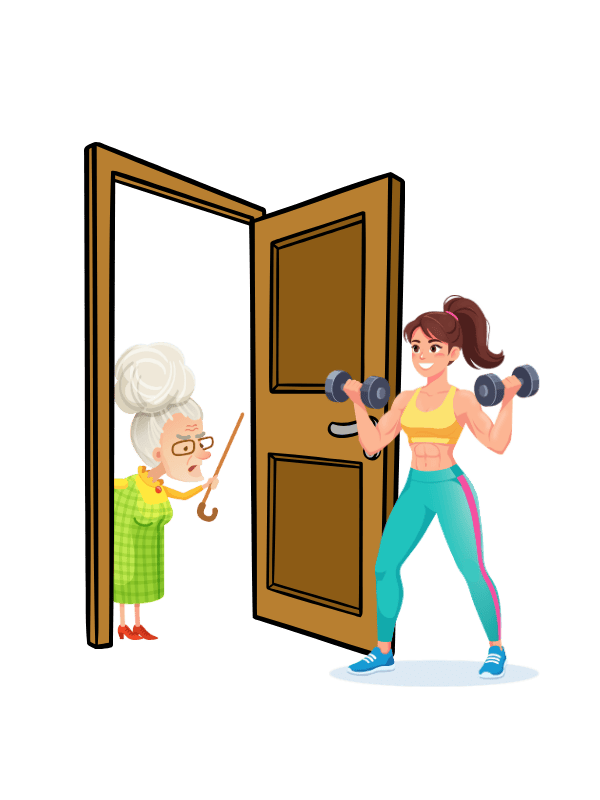
So I think of my workouts as actively avoiding “letting the old lady in.” Don’t get me wrong, the old lady will get her turn, and I’m not scared of her. I just refuse to hand her the keys early. So I fight for it every day, through the tough workouts, and I feel it.
Eat More Than You Think You Should
This is something I never realized, and something I want anyone reading this to know: you have to eat a lot more than you probably think you do.
I eat more now than I ever thought I would, or should. After a lifetime of diet culture, that took some serious unlearning. But you cannot build muscle out of thin air. If you’re training hard and under-eating, your body doesn’t build, it conserves. I think most women don’t eat enough, and it makes everything harder: the workouts, the recovery, the mood, the sleep.
Here’s what that looks like for me:
Protein. The official recommended amount (0.8 grams per kilogram of body weight) is the minimum to keep you from becoming deficient. It isn’t what’s best for someone trying to build or maintain muscle. Research on active people and on women in midlife and beyond generally points toward something like 1.2 to 1.6 grams per kilogram, sometimes higher. For a woman who weighs 150 pounds, that’s roughly 80 to 110 grams a day. It also helps to spread it out over your meals instead of saving it all for dinner.
Fiber. The general recommendation for women is around 25 grams a day, and most of us get about half that. Fiber feeds your gut (remember the gut microbiome?), keeps you full, and makes a high-protein diet a lot more comfortable.
Low fat. My diet is very low in fat, and it works for me. But please don’t take that as a prescription. Your body needs some fat to make hormones and absorb vitamins A, D, E, and K, so fat is not the enemy. Do what works for your body.
If you’re not sure how much you’re eating, try using a food tracking app or writing it all down for a few days in a food diary. Most people are shocked, in either direction. I did a food tracking app for about a month and it totally transformed my diet.
The Supplements
A quick disclaimer: I’m not a doctor or a dietitian. This is what I take and what I’ve learned about why. If you take medications or have health conditions, please check with your doctor or pharmacist before adding anything. (I take medication reviews very seriously.)
Creatine
Creatine is one of the most studied supplements in the world, and it’s not just for guys in gyms. Your body makes some, and you get some from meat and fish, but supplementing helps your muscles recharge quickly for short, hard efforts, like the end of a tough set. Combined with resistance training, it tends to support strength and lean muscle, and it helps with recovery, which is why I take it. The research in postmenopausal women is promising, including some hints about bone and brain health, though it’s not conclusive yet.
The typical dose is 3 to 5 grams of creatine monohydrate per day. You don’t need to “load” it, and when you take it matters much less than taking it consistently. I put mine in my water bottle. It doesn’t fully dissolve, so I shake it and drink it fast. At first you might notice some water weight, and that’s water going into your muscles, it’s not fat. If you have kidney problems, talk to your doctor first.
Collagen Peptides
Collagen is the protein that makes up our skin, tendons, ligaments, cartilage, and bones. Our bodies make less of it as we age, and the drop in estrogen speeds that up. Collagen peptides are collagen that’s been broken into small pieces so it is more bioavailable and dissolves in liquid, even hot coffee, which is how I take mine.
Research on collagen is encouraging but modest. Studies using roughly 5 to 15 grams a day have found small improvements in skin elasticity and some reduction in joint discomfort, especially in active people. I take more than that, about 50 grams, and I do notice a difference particularly in my hips. As with all supplements, your mileage may vary. It is not a miracle, and it’s worth noting that a lot of the studies are funded by the companies that sell it. One more thing worth mentioning: collagen isn’t a complete protein, so it doesn’t count the same as your other protein sources. Pairing it with vitamin C helps your body use it.
Magnesium
Magnesium is a mineral involved in hundreds of reactions in your body, including muscle and nerve function, energy, and bone health. Many women don’t get enough from food, and good sources are pumpkin seeds, leafy greens, beans, nuts, and whole grains.
For sleep, the evidence is modest, and it seems to help most for people who are low to begin with. It appears to help calm the nervous system, and the form matters: glycinate is the one most often chosen for sleep and is gentle on the stomach, citrate can loosen things up, and oxide is poorly absorbed. Magnesium supports your bones and muscles, and that helps support your joints. The upper limit for supplemental magnesium is about 350 mg a day for adults, and I take that much, but you should know that it can interact with some antibiotics, osteoporosis meds, and thyroid medications, so again: what’s right for me isn’t necessarily right for others.
And a daily multivitamin
Think of it as insurance, not a replacement for eating well.
The Unglamorous Stuff
Honestly, the two things that do the most for me these days are sleep and active rest.
I sleep about 9 hours a night. That’s when your body actually does the repairing and building, and no supplement on earth can make up for it. And I rarely drink alcohol anymore, because I noticed even the smallest amounts show up everywhere: in my sleep, in my workouts, in how I feel the next day. It’s often not worth the trade. Sometimes it is though. 🙂
And I take rest days. Every few days I listen to my body and give it what it asks for. The trick, which I’m still learning, is telling the difference between “I’m tired and need a break” and “this is hard and I don’t want to.” Only you can make that call.
Try Things. See What Works.
These things work for me, as I write this now. But my body is always changing, every person is different, and every body has its own needs, its own history, its own pace. I’m not offering a plan. I’m offering permission to try things: a different kind of workout, a new way of eating, a supplement you read about, and to pay attention to how you feel.
Work out. Work out as hard as you can. Eat enough to do it. Sleep. Rest. Lift heavy… for you.
And let’s keep the old lady waiting a little longer.
Peace and love to you, wherever this message finds you.

Other blogs you may enjoy:
Menopause: What It Is, What It Isn’t, And How To Get Through It In One Piece


Leave a Reply